From Embodied Experience to Collective Action: An Autoethnography of a Manipuri Dancer's Artistic Response to Ethnic Violence

Overview

This MFA thesis examines how the ongoing ethnic violence in Manipur, India, has shaped my embodied experience, artistic identity, and dance practice as an Indo- American Manipuri dancer. Combining personal narrative with fieldwork, participant observation, and semi-structured interviews conducted under IRB guidelines, the study investigates how artists, teachers, and communities sustain themselves through art amid sustained crisis, and how artistic practice can be transformed into collective action that reaches from Manipur to Western audiences.

The thesis documents this journey from embodied experience to collective action through:

  • A dance film
  • A stage production
  • A fundraising initiative that carried the story of my homeland to Western audiences while returning material relief to affected communities
Background and Rationale

  • Since May 2023, Manipur has been the site of severe ethnic violence. By September 2024, more than 200 people had been killed and over 60,000 displaced, many living in temporary shelters and relief camps (Human Rights Watch, 2024) (Das, 2026, p. 21).
  • The disruption extends to education, employment, healthcare, artistic training, and cultural spaces. For artists, violence disrupts not only daily life but the very systems through which artistic knowledge is transmitted (Human Rights Watch, 2024).
  • The existing literature leaves a significant gap: it offers little exposure to how arts and culture enable victimized communities to survive through creative practice, memory, silence, and emotional endurance. In Manipur's multilingual setting, coping mechanisms based on art are integral to the culture rather than an external influence (Rani & Samjetsabam, 2024) (Das, 2026, p. 23).

My study:

  • Shifts the conversation from externally driven accounts to an internal one, centering artists' lived accounts of coping as a social process
  • Employs autoethnography, a rare method in ethnic violence studies
  • Records the lived experiences of the Manipuri community before they are lost
  • Brings attention to the coping strategies of artists and their ability to persevere
  • Gives an international voice to frequently ignored victims
  • Highlights the role of women, particularly the Meira Paibis, who hold the community's memories and lead with courage

Research Questions

At the heart of the thesis are questions of cultural translation and ethical response raised by my choreographic work, which brings Manipuri dance into dialogue with other Indian classical, contemporary, and modern forms:

  • How can a Manipuri narrative be presented to audiences in the United States without simplifying its cultural complexity?
  • How can traditional movement be recontextualized without treating it simply as symbolic or decorative?
  • How can a performance respond ethically to communal trauma while leaving room for imagination, transformation, and hope?
  • A further question animates the whole project: why would an artist comfortably settled in the West, geographically and socially removed from the crisis, choose to enter it?

Methodology

  • The study uses autoethnography, understood as the systematic description and analysis of personal experience to gain understanding of cultural experience (Ellis, Adams, & Bochner, 2011), applied here to both my artistic growth and my embodied experience within Manipuri dance, culture, and resilience (Das, 2026, p. 24).
  • Dance-based autoethnography produces knowledge that challenges conventional academic practice and opens space for relational, reflexive, and socially engaged inquiry (Van Katwyk & Seko, 2017).
  • The autoethnographic design integrates participant observation, fieldwork, and interviews to explore the transformative power of dance as a tool for resilience during the ongoing crisis.
  • Semi-structured interviews were conducted with artists, teachers, and community members affected by the conflict, following IRB guidelines.

Participant groups spanned teachers and gurus, university students, professional artists, a theatre actress, relief-camp residents, Meira Paibi women, and local artists, interviewed in homes, studios, university spaces, rehearsal spaces, and relief camps.

Participant Groups

Participant groups spanned teachers and gurus, university students, professional artists, a theatre actress, relief-camp residents, Meira Paibi women, and local artists, interviewed in homes, studios, university spaces, rehearsal spaces, and relief camps.

Analysis and ethics:

  • Thematic coding moved from in-vivo codes through focused codes to analytical categories: cultural leadership as social resilience, livelihood collapse and emotional crisis, youth resilience under violence, women-led protection and resistance, and art as resilience and quiet resistance (Das, 2026, p. 49)
  • Informed consent and altered identifying details
  • How can a performance respond ethically to communal trauma while leaving room for imagination, transformation, and hope?
  • Testimony recorded as personal experience rather than verified fact, and an ongoing promise of reciprocity to camp residents (Das, 2026, p. 53)

Key Findings

Consequences of the crisis:

  • Education and training were seriously disrupted: examinations at Manipur universities and in-person classes stopped, students sheltered on campus during the riots, and the psychological toll on art students compounded what COVID-19 had already taken (Das, 2026, p. 50)
  • Artists' livelihoods collapsed into survival; because Manipuri dance is barely known outside Manipur, earning outside the state was nearly impossible, and artists without university posts or urban networks suffered most
  • A theatre actress had been out of work for over a year, exhausted her savings, and attempted suicide (Das, 2026, p. 50)
  • Interviewees reported government inaction, including only token assistance from the Ministry of Culture for recognized artists

Mechanisms of community endurance:

  • Teachers and gurus counseled students to keep calm, have faith, remain in Manipur, and not respond to violence with violence, exercising protective mentorship that functions as cultural leadership and social resilience
  • Students expressed attachment to land and family, women's resilience, and cultural activism, with martial arts understood as protection rather than aggression
  • The Meira Paibis, the women torchbearers whose movement traces back to the Nupi Lan (Women's Wars) of 1904 and 1939 (Oinam & Thoidingjam, 2020), emerged as one of the most important manifestations of women's initiative and activism in Manipur, living by the principles of "alertness" and "guarding the family" (Sophia, 2021) and functioning as grassroots security and informal guardians of justice (Saisin & Chaisingkananont, 2026): guarding families at night, fighting for government aid, and holding community memory
  • Even as livelihoods collapsed, local artists kept making art despite the crisis, a form of artistic persistence that reads as resilience and quiet resistance

Conclusion of the analysis

Dance involves more than performance. When violence and instability are present, Manipuri dance maintains identity, expresses grief, and preserves dignity, while teachers, senior artists, and cultural mentors exert a stabilizing influence on younger dancers and students (Das, 2026, p. 54).

Creative Outputs and Impact

Lines Up (dance film):

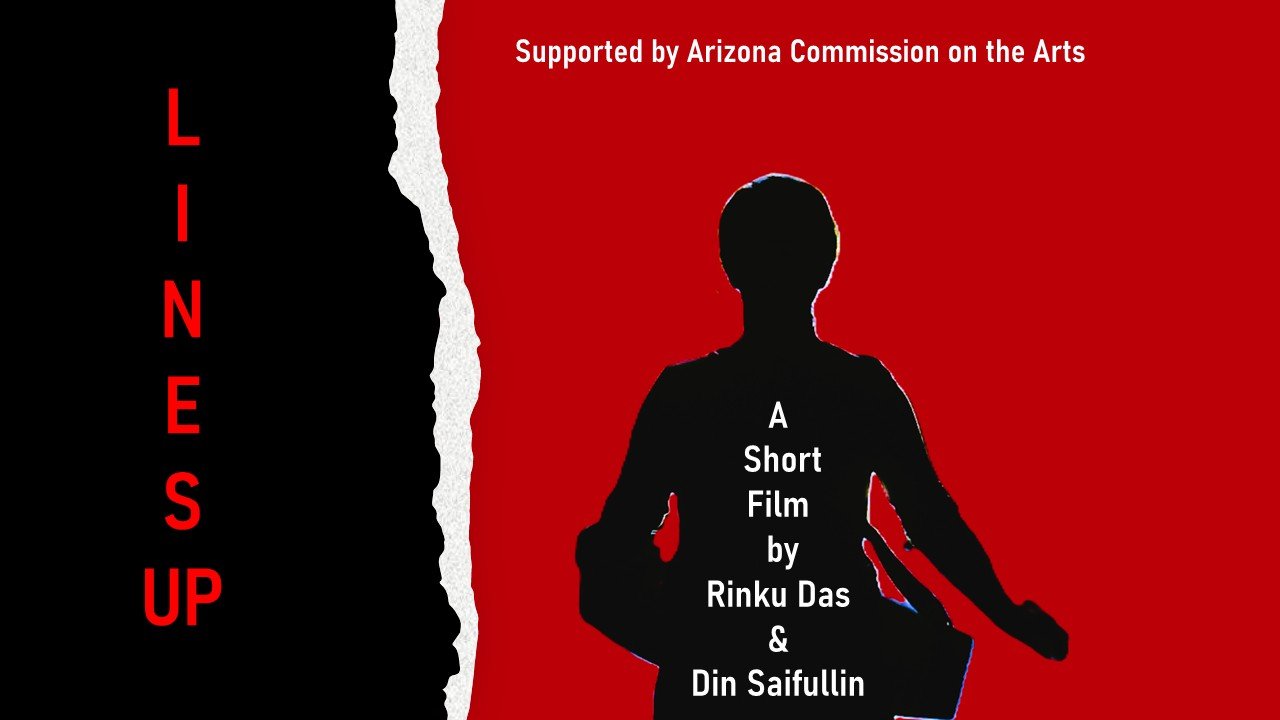
  • Developed from the accumulated fieldwork; began as a documentary project with Ri Lindegren and evolved into a dance film in collaboration with editor Dean Saifullin, under the supervision of Professor Mary Fitzgerald and with support from the Arizona Commission for the Arts. Transcending local boundaries, this film depicts the struggles of Manipur (a northeastern state in India) into a universal metaphor for conflict and suffering that echoes around the globe.
  • The title draws on the call to action in Ibeyi's #Hamildrops song "Rise Up" (Ibeyi, 2018), expressed through the film's phrases "Eyes up, Wise up, Lines up" as a response to the loss and resilience in my homeland
  • Premiered at the first-ever benefit concert organized by the CCDR at ASU and was well received, with Indian platforms now interested in airing it

Echoes of Strife, Rhythms of Resilience (stage production):

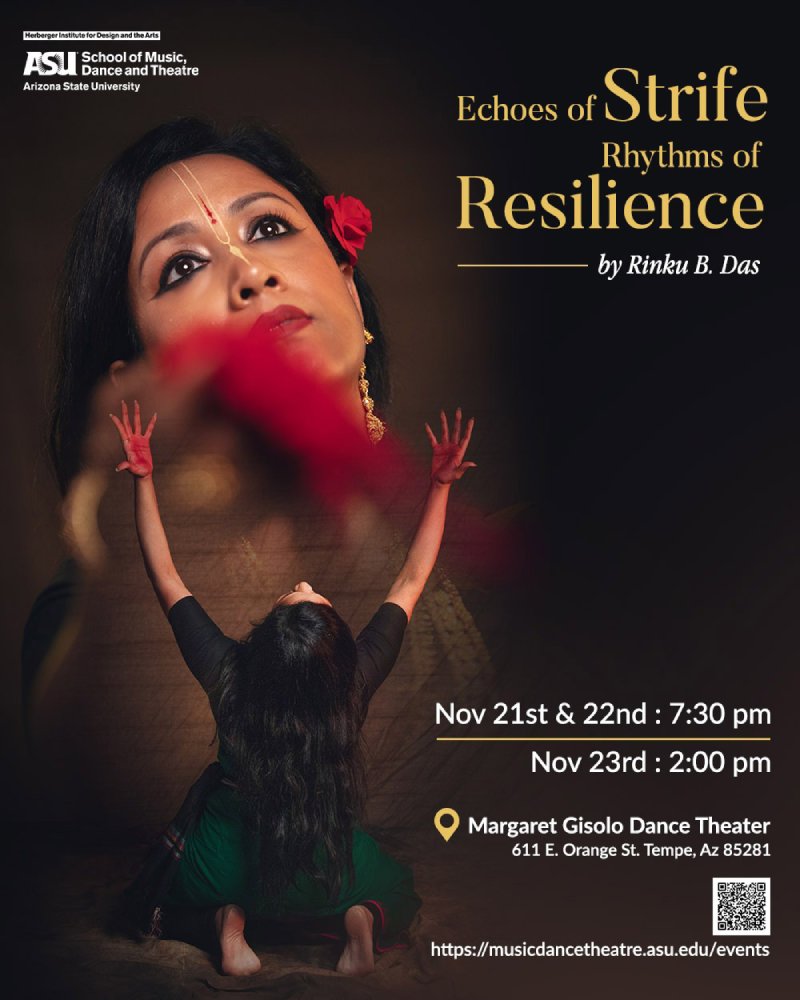
  • Deconstructs Manipuri movement: rather than simply adding contemporary technology or changing the story, it investigates what Manipuri dance can become when its movement is learned, interpreted, and embodied outside Manipur, performed by American student dancers at Arizona State University
  • The deconstruction follows the principle that taking apart a tradition is not abandonment but faithful reinterpretation and embodied knowledge production (Roberts, 2021), a resignification of traditional gestures for contemporary contexts (Taylor, 2003), and a practice reserved for those intimately connected to the tradition (Klunchun, 2020)
  • Performed over three days to full audience support, warmly welcomed, and drew appreciation from faculty, CCDR leadership, and committee members
  • Proceeds collected from the programme were contributed to the relief camp
  • The closing image, my daughter standing alone in ragged attire at the back of the stage, returned the audience to the reality that violence in Manipur continues

Impact and Philanthropy

  • The production's closing connected directly to action: a GoFundMe campaign linked to the performances drew donations from across the United States.
  • In January 2026, I returned to Manipur and, together with Dr. Sohini Ray, Meira Paibi leader Iche Anita, and Manipur University colleagues, distributed funds in person, family by family, at the relief camps, so that every contribution reached the people for whom it was intended.
  • The distribution was covered by Manipuri television and newspapers, including The Sangai Express and The People's Chronicle, which helped mobilize further support for the state's artists and displaced communities.
  • The work creates a circular relationship between art, community, and activism: stories travel from Manipur to the West through dance, and attention, empathy, and material support travel back.

Scholarly Contribution and Significance

  • Theoretical: contributes to the development of autoethnographic and arts-based research in conflict-affected areas, demonstrating how a dancer's body can serve as a site of memory and analysis
  • Practical: raises awareness of rare art forms such as Manipuri dance and builds bridges between Eastern and Western cultural contexts
  • Social: offers a model for how cultural organizations, educators, and community leaders can support artists during crises
  • Social: offers a model for how cultural organizations, educators, and community leaders can support artists during crises
  • Ethical: promotes humanitarian responses that regard artists as individuals with knowledge rather than simply as victims
  • Choreographic: by placing Manipuri movement on non-Manipuri bodies and making that difference visible, the work asks what is essential to a classical tradition: its costumes, its ritual settings, its narratives, the cultural identity of its performers, or the movement itself

The thesis ultimately argues that artistic response to traumatic events should not stop at awareness or emotional engagement but instigate meaningful change by building relationships, mobilizing support, and providing material assistance. My position in the West is integral to this design, providing opportunities, connections, and resources to reach a larger audience and generate meaningful support for struggling artists, with goals of integrating pedagogy and performance, raising awareness of the dance form in the West, and generating humanitarian assistance.

Limitations, acknowledged with care:

  • Autoethnographic findings cannot be statistically generalized
  • Insider positionality gave access and trust but challenged critical distance
  • The researcher's base in the West prevented continuous observation
  • The conflict remains ongoing, limiting documentation and verification

The study does not claim that dance resolves political conflict. What it demonstrates is that choreography can serve as an act of witnessing, a means of preserving cultural continuity, and a bridge of solidarity between East and West. It shows that dance has no geographical limits and that artists everywhere share the same emotional life, suggesting comparable projects are possible for other rare and endangered art forms.

The thesis stands as a record of a community's fight for survival: people refusing to abandon life, their art, their spirituality, or one another. I intend to continue working at this intersection, creating significant projects within Manipuri culture, supporting art forms in crisis, and passing this knowledge on as a researcher and scholar.